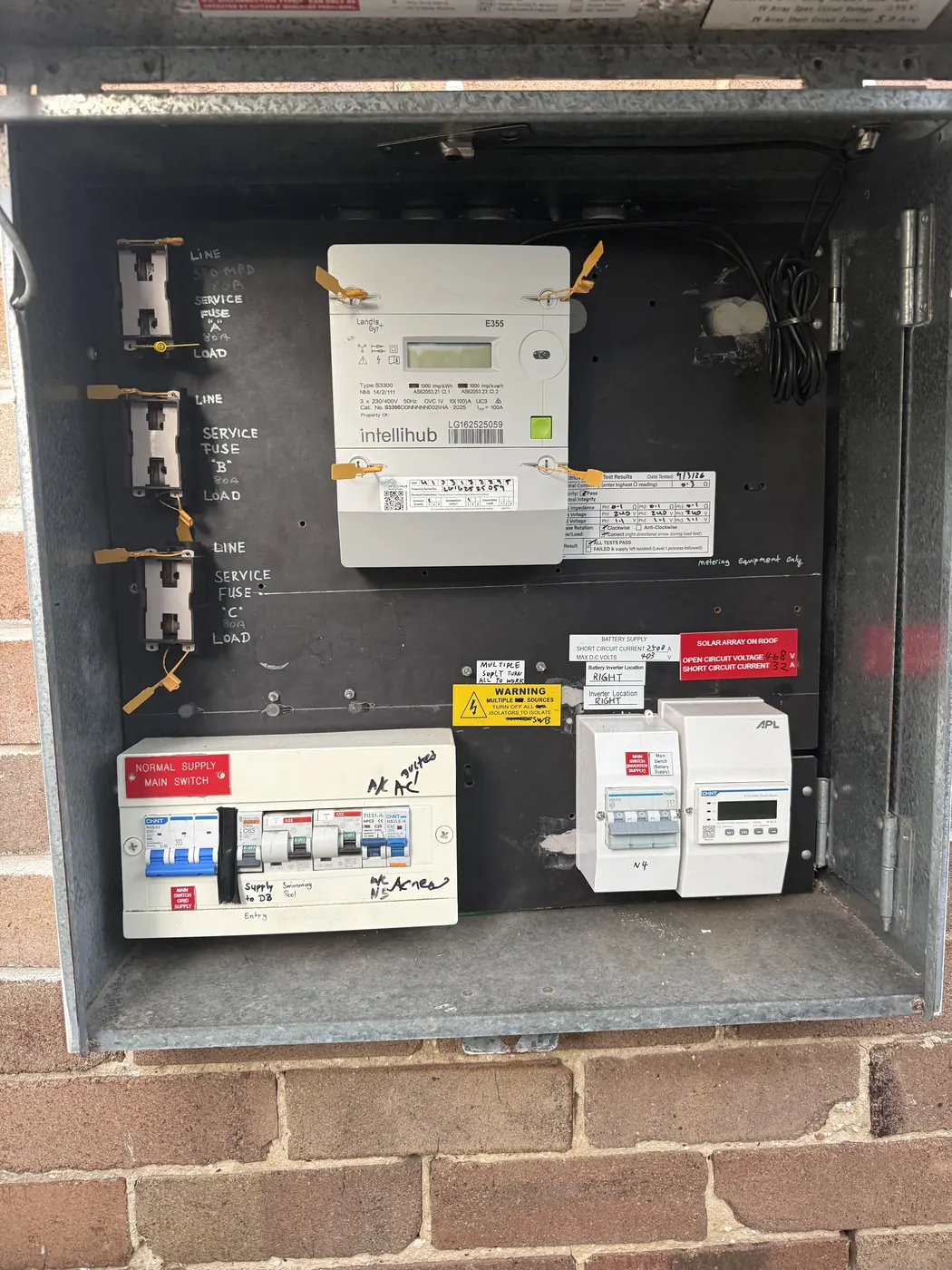
Apartment switchboard: do you pay, or does strata?
In short: the sub-board and circuit breakers inside your apartment are yours. The meters, the metering area and the mains feeding them belong to the owners corporation. Most arguments happen right where the two meet.
Who pays for what
The usual position under NSW strata law. Your strata plan and by-laws can shift the detail, so check them.
| The job | Price |
|---|---|
| Your sub-board and its breakers or fusesSupplies your apartment only | You (lot owner) |
| Wiring, switches and outlets in your unitInside the lot boundary | You (lot owner) |
| Meters and the meter cupboard or roomCommon property, even though each meter serves one unit | Owners corporation |
| Mains and risers up to the metersThe building’s shared supply | Owners corporation |
| Switchboards for shared areasFoyers, stairwells, garages and lifts | Owners corporation |
| Your sub-board damaged by a common-property faultFor example, a failing shared main or riser | Usually owners corporation — confirm in writing before paying |
This is general guidance, not legal advice. Your strata plan and by-laws set the exact boundary, and your strata manager or a strata lawyer should confirm anything in dispute.
Why it comes up so often here
Strata is everywhere in the Eastern Suburbs — inter-war walk-ups in Bondi, Coogee and Randwick, red-brick blocks in Rose Bay, Double Bay and Bellevue Hill, and newer towers around Bondi Junction. In almost every building, people agree on the rule of thumb. The argument is about which side of the line a particular fault sits on.
A tripping RCBO inside your unit is clearly yours. A dead light in the meter room is clearly the owners corporation’s. The grey area is in between: a failing meter dragging your sub-board down with it, a tired shared riser causing nuisance trips in several units, or an old combined board where the meters and the unit circuits were never properly separated. That last one is common in older blocks wired before separate metering areas became standard.
Beachside buildings add one more: salt air. A rusting meter enclosure or corroded connections in a common-property meter cupboard are the owners corporation’s to fix, even when the symptoms show up in your unit.
Upgrading the board in your unit
The board that serves only your unit is part of your lot, so upgrading it generally doesn’t need a vote or approval — it’s much like replacing your own hot water unit. Before booking, check three things:
- Is your board really separate? In some older buildings, unit circuits and common-property metering share an enclosure. Untangling them is worth doing while the work is happening.
- Where is it? If it lives in a shared cupboard, stairwell or riser, tell the strata or building manager when the work is booked. You’re giving notice, not asking permission.
- What do your by-laws say? Some schemes require notice for trades using common areas or set rules for work near common property. Better to know before the booking than after.
Pricing for a single-phase sub-board is the same as for a house — see the switchboard upgrade cost guide.
Apartment switchboard questions
Is the switchboard my cost or the owners corporation’s?
Anything inside your lot — the sub-board, its breakers and your unit’s wiring — is yours. The meters, the metering area and the mains supplying them are common property and belong to the owners corporation. In most buildings the meter marks the boundary.
Does strata have to approve a sub-board upgrade?
Usually not, because the board is inside your lot. If the work needs access to a shared cupboard or riser, give the strata or building manager notice.
The strata manager says it’s my problem. What now?
Ask your electrician to put it in writing: what failed, and whether it sits inside your lot or on common property. Give that to the strata manager or committee — a clear technical finding settles most disagreements. If it doesn’t, NSW Fair Trading offers strata mediation, or you can speak to a strata lawyer.
A fault on common property damaged my sub-board. Who pays?
Generally the owners corporation, since the cause was on common property. Take photos and get a written report on the cause before anything is repaired, and raise it with the strata manager or committee before paying out of your own pocket.
Our floor shares one old combined board. Is that a problem?
It’s a leftover from before separate metering areas were standard, and it blurs who is responsible for what. Raise it with the owners corporation — splitting it into individual metering and sub-boards is normally a common-property capital works job, not a cost for one owner.
What customers say
Excellent value and service, including follow-up.
Jason onsite quickly and completed the work on the spot, giving us a good price and was very polite. Would highly recommend.
Reliable and quality service.
These are Google reviews for Cync Electrical & Automation. 5.0 from 20 reviews. — see the profile
Which side of the line is your fault on?
Send a photo of the board and tell us what it’s doing — we’ll explain what we see. Call 0411 498 916.