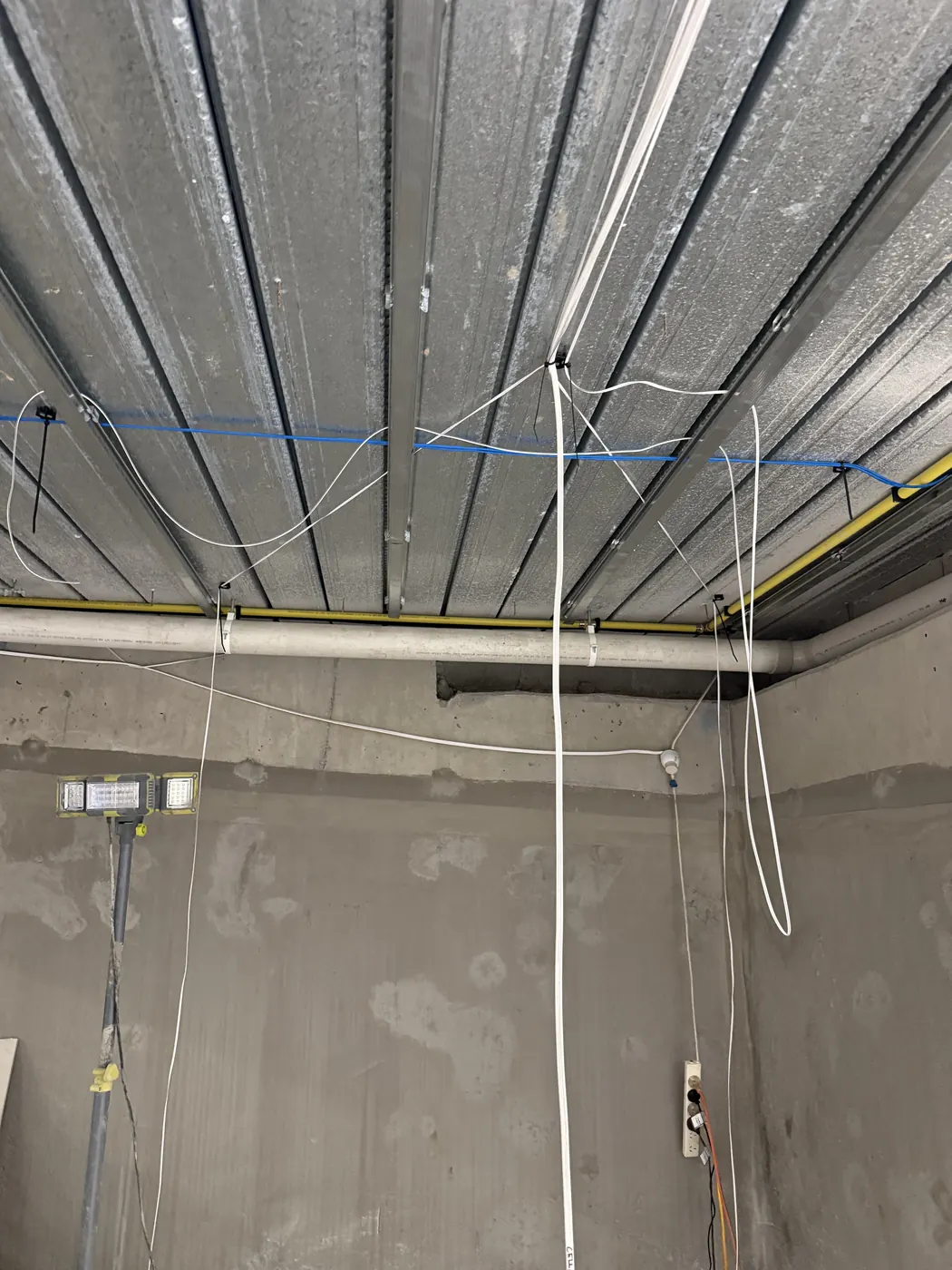
Data cabling and network points
Wi-Fi is convenient. Cable is dependable. When the signal has to get through double brick or a concrete slab, you want cable.
Why cable still wins
Mesh Wi-Fi has come a long way, and in a small, open apartment it’s often all you need. The trouble is the buildings that are common around here.
A terrace is long and narrow, with the internet connection at the front and the kitchen and back bedroom at the far end — and between them, solid brick walls that soak up radio signal. Inter-war apartment blocks are often thick masonry with concrete floors. Larger harbourside homes spread over several levels separated by concrete slabs. In all of them, the Wi-Fi is strong in one room and useless two doors away.
A bigger router doesn’t fix that. Cable to well-placed access points does: each one covers a sensible area and hands over cleanly to the next. Two properly located access points on cable will beat five mesh nodes trying to relay through brick.
What we install
Cat6 and Cat6A points
Each one terminated at both ends and certified with a tester.
Wi-Fi access points
PoE powered, on the ceiling or wall, positioned where the coverage is needed.
Comms cabinets and patch panels
An organised home for the modem, switch and cables.
Network to studios and garages
Back-of-block studios, rear-lane garages and pool houses, where Wi-Fi gives up.
TV and streaming points
A cable to the TV so the stream stops buffering.
Cabling for cameras
Camera cables run at the same time as the data.
Getting cable through a terrace or an apartment
The hard part of data cabling here is rarely the distance. It’s the route.
Terraces. Internal walls are often solid brick, and there’s usually no access between the ground floor and the floor above. We use the subfloor, the roof space and any existing cavities first, and where there’s no hidden route, a slim skirting duct or a neatly painted conduit beats chasing into old plaster.
Apartments. With concrete floors and ceilings, the options are existing conduits (old phone or TV runs can sometimes be reused), bulkheads, and skirting ducts. The internet connection usually arrives wherever the original phone point was, often in a hallway or a cupboard, and moving it to somewhere sensible is a common first job. Anything that crosses common property needs the owners corporation’s say.
Studios and rear-lane garages. Copper Ethernet has a practical limit of about 100 metres. If the run is longer, or shares a trench with a power cable, fibre is the better choice — it doesn’t pick up electrical noise and doesn’t carry a surge from one building to another. If a trench is being dug for power anyway, a data conduit alongside costs very little.
What data cabling costs
Sydney, 2026. You’re mainly paying for the route the cable takes, not the outlet on the wall.
| The job | Price |
|---|---|
| One extra Cat6 point in a finished homeMostly decided by how we get cable through walls and ceilings | $180 – $400 each |
| Further points on the same routeEach one costs less once the route is open | from $130 each |
| Wi-Fi access point on the ceilingCable, bracket and PoE — the access point itself is extra | $250 – $500 each |
| Comms cabinet and patch panelOne tidy place where every cable ends | $450 – $1,200 |
| Data link to a studio, garage or pool houseCopper up to about 100m, fibre past that | $800 – $3,500+ |
| Cabling during a build or renovationBefore the plaster goes on, at a fraction of retrofit cost | ask |
These are indicative market ranges for Sydney in 2026, not a quote. What you pay depends on your switchboard, access and what we find. We confirm a fixed price before starting, and it doesn’t move.
Data cabling questions
Isn’t mesh Wi-Fi good enough now?
In a small open-plan apartment, often yes. In a terrace with solid brick walls, or a multi-level home with concrete floors, no — the nodes struggle to talk to each other. Two cabled access points will outperform five mesh nodes relaying through masonry.
Cat6 or Cat6A?
Cat6 handles 10 gigabit over the distances in a normal home and suits almost everyone. Cat6A matters for longer 10 gigabit runs. The cable is a small part of the job cost, so it’s worth asking about if we’re running it anyway.
Can you get cable into my apartment without chasing concrete?
Usually. We look for existing conduits first, then bulkheads, skirting ducts and cornice-height trunking. If a route would cross common property, we’ll tell you before anything goes ahead.
Can you run network to a studio or garage at the back?
Yes. Up to about 100 metres, standard copper cable is fine. Further than that, or alongside a power cable in the same trench, we run fibre, which ignores electrical interference and can’t carry a surge from one building to the next.
Should I run data while I’m renovating?
Definitely — it’s the cheapest it will ever be. Rough-in before the plaster goes on costs a fraction of retrofitting through finished walls. Put in more points than you think you need.
Do you set up the network as well?
We run, terminate and test the cabling and fit the access points. Simple routers and switches we’ll configure ourselves; for anything more complex we work alongside your IT person.
Is data cabling licensed work?
It is. In Australia, permanent data cabling must be done by a registered cabler — a separate registration from an electrical licence. We hold both.
What customers say
He was a very kind and pleasant person. He fixed the internet issue very quickly, and didn't leave any mess behind. He will definitely be the first person I call for any electrical problem.
Jason solved a really complex problem for our house with excellent professionalism and workmanship. Highly recommend, would def work with him again. On time delivery and within budget.
Jason onsite quickly and completed the work on the spot, giving us a good price and was very polite. Would highly recommend.
These are Google reviews for Cync Electrical & Automation. 5.0 from 20 reviews. — see the profile
Wi-Fi not reaching the back of the house?
Tell us where the signal drops out and how the place is laid out. Call 0411 498 916.