Solar battery installation and retrofit
Where the battery can legally go, which circuits it keeps running in a blackout, and how that’s wired — the parts a package price tends to leave out.
A battery doesn’t keep the lights on by default
This surprises a lot of owners. A battery installed without backup circuits switches off in a blackout along with everything else. Grid-connected inverters must disconnect when the grid goes down, so they don’t send power back into lines that workers may be repairing. Plenty of people find this out in their first outage, standing next to a fully charged battery in a dark house.
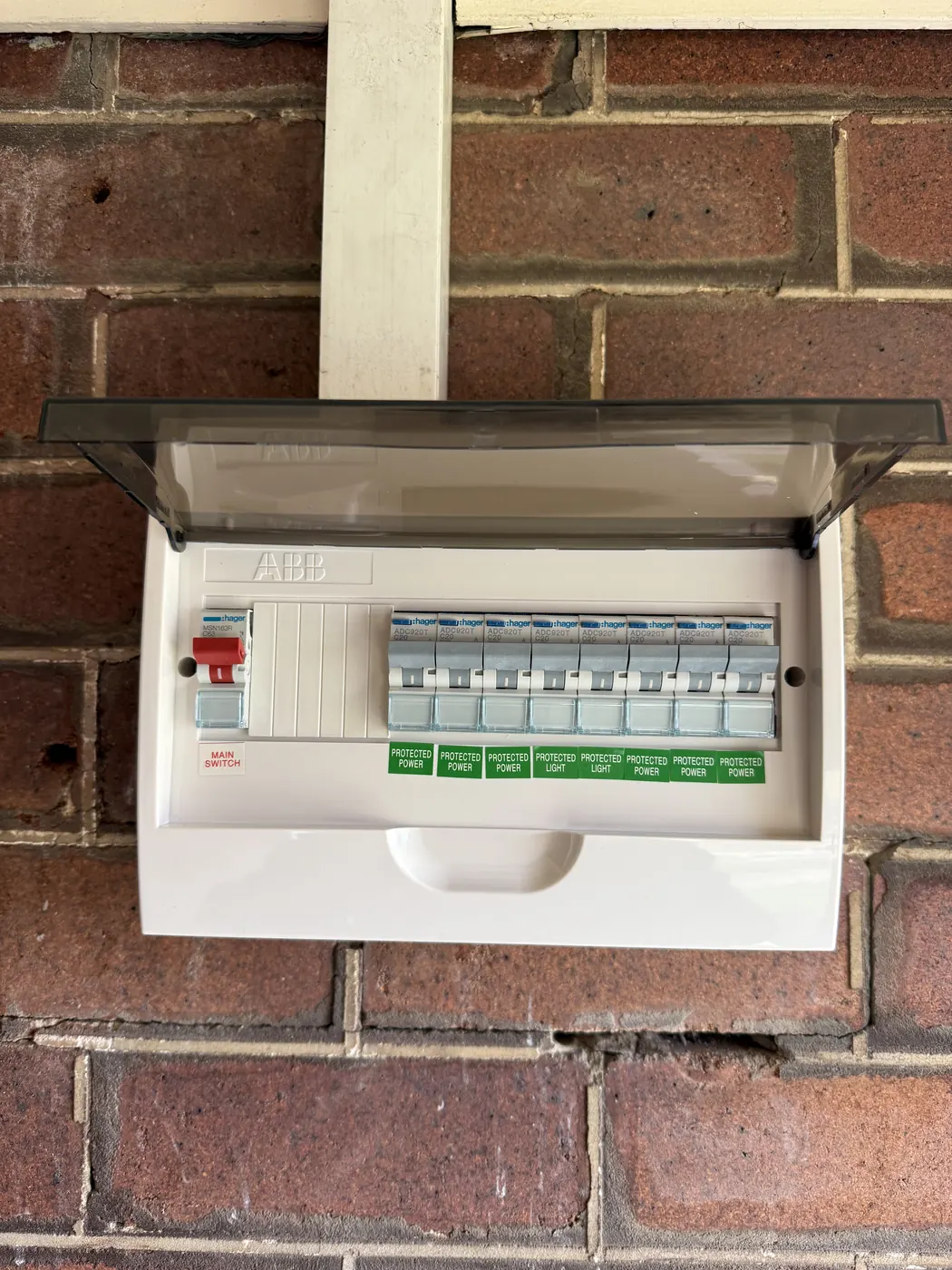
To get blackout protection, the battery system needs backup capability, and the circuits you want kept alive have to be wired onto the protected side of your installation. That’s switchboard work, and it’s the part most often missing from a package price.
Whether backup is worth paying for is a fair question. Outages are less of a feature of life in the Eastern Suburbs than in heavily treed parts of Sydney, but they do happen — and if you work from home, keep medication refrigerated, or rely on an automated gate, lift or security system, a few hours without power matters. Decide before you sign, because it changes the wiring and the price.
Where a battery can go — the Eastern Suburbs problem
The Australian Standard for home battery installations restricts where a battery can be mounted: not in habitable rooms, ceiling spaces or wall cavities, not under stairs or along escape routes, and with clearances from doors, windows and other openings. On a large block that’s easy. Here it often isn’t.
- Terraces may have nowhere suitable except a rear courtyard wall or a garage off the lane, and those need weather protection and clearance from the neighbour’s windows.
- Houses near the water need an enclosure and location chosen with salt air in mind, so the battery and its connections aren’t sitting in the spray.
- Apartments are the hardest. Balconies and shared car parks raise fire-safety and common-property questions, and most buildings will need owners corporation approval. In practice, an individual battery in an apartment is often not possible.
We’ll tell you early whether there’s a compliant spot, before you’ve paid a deposit to anyone.
Choosing your backup circuits
A home battery can’t run the whole house. Backup capacity is limited, so the aim is to keep the essentials going for a useful length of time rather than everything for twenty minutes.
What we usually put on the protected side:
- Fridge and freezer — the thing that actually costs money in a long outage
- Lighting in the main living areas
- Internet and phones, now often the difference between working and not
- Security, intercom and gate, so you can still get in and out
- The home automation system — on a C-Bus house, the network and key controls, so lighting can still be switched
- A few general outlets for laptops, chargers and any medical equipment
What we usually leave off: air conditioning, electric hot water, the oven, pool pumps and home lifts. Any one of them will drain a domestic battery quickly.
Getting this right at design stage is most of the value. It’s much harder to rearrange later.
Adding a battery to existing solar
Most battery jobs are retrofits onto solar that’s already on the roof. There are two ways to do it:
AC-coupled — the battery brings its own inverter and sits alongside your existing solar inverter, which stays put. Simpler, leaves a working system alone, and sensible if your inverter is fairly new.
DC-coupled / hybrid — your existing inverter is replaced by a hybrid that runs both the panels and the battery. A little more efficient, and an obvious choice if your inverter is eight or more years old and close to the end of its life. If it’s already failing, a hybrid is usually a better replacement than like for like — see solar repairs.
Either way, the switchboard usually needs work. Older Eastern Suburbs boards — particularly in terraces that have never been rewired — often have no room and no RCD protection. Know that before comparing package prices that leave it out.
What the electrical side costs
Sydney, 2026. The battery itself is usually supplied and installed as a package — these are the electrical items around it.
| The job | Price |
|---|---|
| Backup circuit wiring at the switchboardMoving your chosen circuits onto the protected side. The item most often missing from a package price | $800 – $2,200 |
| Switchboard upgrade to accept a batteryWhere the board is full or has no RCD protection | $1,500 – $3,500 |
| Hybrid inverter changeover, electrical workWhere an ageing inverter is replaced as part of the job | $600 – $1,400 |
| Surge protection for battery and inverterProtects the most expensive electronics in the house | $400 – $900 |
| Pre-battery assessmentWhere a battery can legally go, and what your board and solar can take | $180 – $350 |
These are indicative market ranges for Sydney in 2026, not a quote. What you pay depends on your switchboard, access and what we find. We confirm a fixed price before starting, and it doesn’t move.
Solar battery questions
Will a battery run my house in a blackout?
Only if it’s installed with backup circuits, and only those circuits. Many batteries go in with no blackout capability at all, and the owner finds out in the first outage. If backup matters to you, say so before signing anything.
Can I install a battery in my apartment?
Often not. The battery standard limits where batteries can go, and balconies, car parks and storage cages raise fire-safety and common-property questions that need owners corporation approval. We can tell you quickly whether there’s a realistic option in your building.
Which circuits should I back up?
Fridge and freezer, main living area lighting, internet, security and gate, your automation network if you have one, and a few general outlets. Leave off air conditioning, electric hot water, the oven, pool pumps and lifts — any of them will flatten a home battery quickly.
Can I add a battery to my existing solar?
Yes. Either AC-coupled, with the battery’s own inverter alongside your existing one, or by replacing your inverter with a hybrid. If your inverter is eight or more years old, the hybrid route usually makes more sense.
What size battery do I need?
Size it to your evening and overnight use rather than your total daily use — the panels cover the day. Since the May 2026 federal rebate tiering, the first 14kWh attracts the full rate, which makes that size or just under the efficient point for most households.
What rebates are available?
The federal Cheaper Home Batteries discount of roughly $300 per kWh, plus a NSW payment of up to about $1,500 for joining a virtual power plant. NSW’s own standalone battery rebate has been paused since July 2025. Our rebate guide has the detail.
Do you sell batteries?
No — we’re electricians, not a solar retailer. We do the electrical work around the battery, which is what decides whether it actually does what you wanted in an outage. We’re happy to work alongside your chosen supplier.
What customers say
Jason solved a really complex problem for our house with excellent professionalism and workmanship. Highly recommend, would def work with him again. On time delivery and within budget.
Jason onsite quickly and completed the work on the spot, giving us a good price and was very polite. Would highly recommend.
Fantastic service! Friendly, efficient and well priced. Highly recommend. Thank you for swiftly fixing our switches.
These are Google reviews for Cync Electrical & Automation. 5.0 from 20 reviews. — see the profile
Comparing battery quotes?
Ask each quote where the battery will go and whether backup circuits are included. If the answers are vague, call 0411 498 916.